

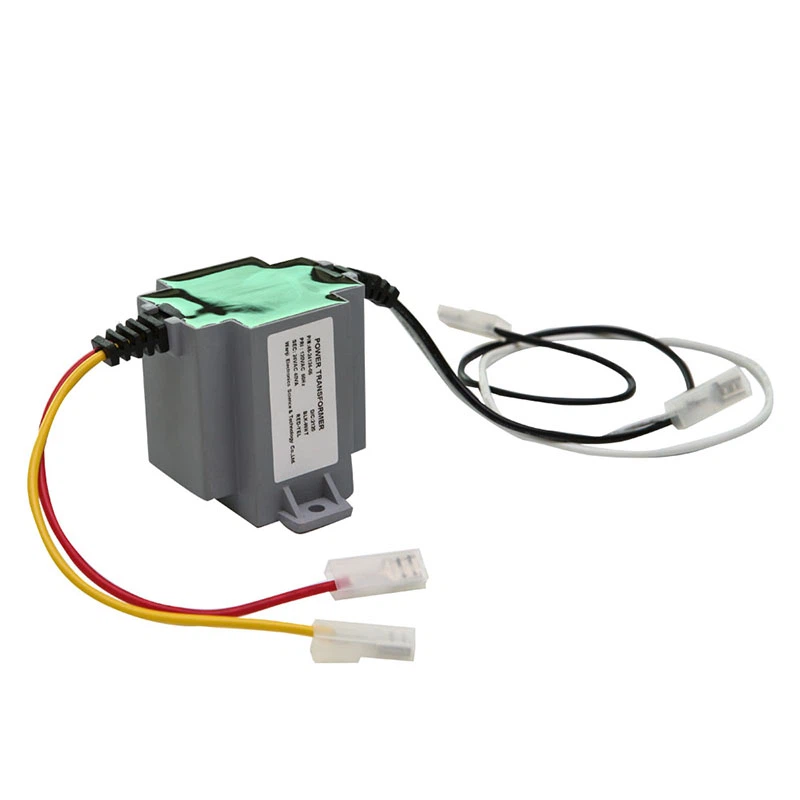
Hey there! As a supplier of PCB Used EI Transformers, I often get asked about how to calculate the thermal time constant of these transformers. It's a crucial aspect, especially when you're looking to ensure the optimal performance and longevity of your transformers. So, let's dive right into it!
First off, what exactly is the thermal time constant? Well, it's the time it takes for a component, in this case, a PCB Used EI Transformer, to reach approximately 63.2% of its final temperature rise when subjected to a constant power input. In simpler terms, it tells us how quickly the transformer heats up and cools down.
Why is the Thermal Time Constant Important?
Understanding the thermal time constant is vital for several reasons. For one, it helps in determining the safe operating limits of the transformer. If you know how quickly it heats up, you can avoid overheating, which can lead to premature failure and costly replacements. Additionally, it's useful for designing cooling systems. By knowing the thermal time constant, you can size the cooling components, like heat sinks or fans, appropriately.
Factors Affecting the Thermal Time Constant
Before we get into the calculation, let's take a look at the factors that can influence the thermal time constant of a PCB Used EI Transformer.
- Material Properties: The materials used in the transformer play a significant role. For example, the thermal conductivity of the core material and the winding insulation can affect how quickly heat is transferred. A higher thermal conductivity means heat can dissipate faster, resulting in a shorter thermal time constant.
- Geometry: The physical shape and size of the transformer also matter. A larger transformer will generally have a longer thermal time constant because it has more mass to heat up or cool down. Similarly, the layout of the windings and the core can impact heat transfer.
- Ambient Conditions: The temperature and humidity of the surrounding environment can affect the thermal time constant. In a hot and humid environment, the transformer may take longer to cool down, increasing the thermal time constant.
Calculating the Thermal Time Constant
Now, let's get to the nitty-gritty of calculating the thermal time constant. There are a few different methods, but I'll go over a relatively simple one here.
The basic formula for calculating the thermal time constant (τ) is:
τ = C / P
Where:
- τ is the thermal time constant in seconds
- C is the thermal capacitance in joules per degree Celsius (J/°C)
- P is the power dissipation in watts (W)
Determining the Thermal Capacitance (C)
The thermal capacitance represents the amount of heat energy required to raise the temperature of the transformer by one degree Celsius. It can be calculated using the following formula:

C = m * c
Where:
- m is the mass of the transformer in kilograms (kg)
- c is the specific heat capacity of the transformer materials in joules per kilogram per degree Celsius (J/kg°C)
The specific heat capacity is a property of the materials used in the transformer. You can find typical values for common materials in engineering handbooks or online resources.
Determining the Power Dissipation (P)
The power dissipation is the amount of electrical power that is converted into heat within the transformer. It can be calculated by measuring the input power and the output power and taking the difference:
P = Pin - Pout
Where:
- Pin is the input power in watts (W)
- Pout is the output power in watts (W)
You can measure the input and output power using a power meter.
Example Calculation
Let's say we have a PCB Used EI Transformer with the following specifications:
- Mass (m): 0.5 kg
- Specific heat capacity (c): 500 J/kg°C
- Input power (Pin): 50 W
- Output power (Pout): 45 W
First, we calculate the thermal capacitance (C):
C = m * c
C = 0.5 kg * 500 J/kg°C
C = 250 J/°C
Next, we calculate the power dissipation (P):
P = Pin - Pout
P = 50 W - 45 W
P = 5 W
Finally, we calculate the thermal time constant (τ):
τ = C / P
τ = 250 J/°C / 5 W
τ = 50 seconds
So, in this example, the thermal time constant of the transformer is 50 seconds. This means that it will take approximately 50 seconds for the transformer to reach 63.2% of its final temperature rise when subjected to a constant power input of 5 watts.
Applications and Considerations
Now that you know how to calculate the thermal time constant, let's talk about some practical applications and considerations.
- Designing Cooling Systems: As mentioned earlier, the thermal time constant is useful for designing cooling systems. If you have a transformer with a long thermal time constant, you may need a more robust cooling system to prevent overheating. On the other hand, if the thermal time constant is short, a smaller cooling system may be sufficient.
- Thermal Management in PCB Design: When designing a PCB that uses an EI transformer, it's important to consider the thermal time constant. You can optimize the layout of the PCB to improve heat transfer and reduce the thermal time constant. For example, you can place the transformer near a heat sink or use copper pours to enhance heat dissipation.
- Monitoring and Maintenance: Monitoring the thermal behavior of the transformer can help you detect potential issues early. By measuring the temperature over time and comparing it to the expected thermal time constant, you can identify if the transformer is overheating or if there are problems with the cooling system.
Our Product Range
As a supplier of PCB Used EI Transformers, we offer a wide range of products to meet your needs. Whether you're looking for EI Medical Power Transformers, Multiple EI Secondary Power Transformers, or High-Frequency Control Transformer, we've got you covered.
Our transformers are designed and manufactured to the highest standards, ensuring reliable performance and long service life. We use high-quality materials and advanced manufacturing processes to minimize power losses and maximize efficiency.
Contact Us for Procurement
If you're interested in purchasing our PCB Used EI Transformers or have any questions about calculating the thermal time constant, don't hesitate to get in touch. We're here to help you find the right solution for your application.
References
- Incropera, F. P., & DeWitt, D. P. (2002). Fundamentals of Heat and Mass Transfer. John Wiley & Sons.
- Kirtley, J. L. (2004). Electric Machinery Fundamentals. McGraw-Hill.